Two Separate Systems, Often Confused
Almost every homeowner planning an extension, loft conversion or outbuilding in Margate, Ramsgate, Broadstairs or elsewhere in Thanet asks the same question first: "do I need planning permission?" The honest answer is that it depends — and getting it wrong before you start can mean costly delays, a retrospective planning application, or in the worst cases an enforcement notice requiring you to undo the work.
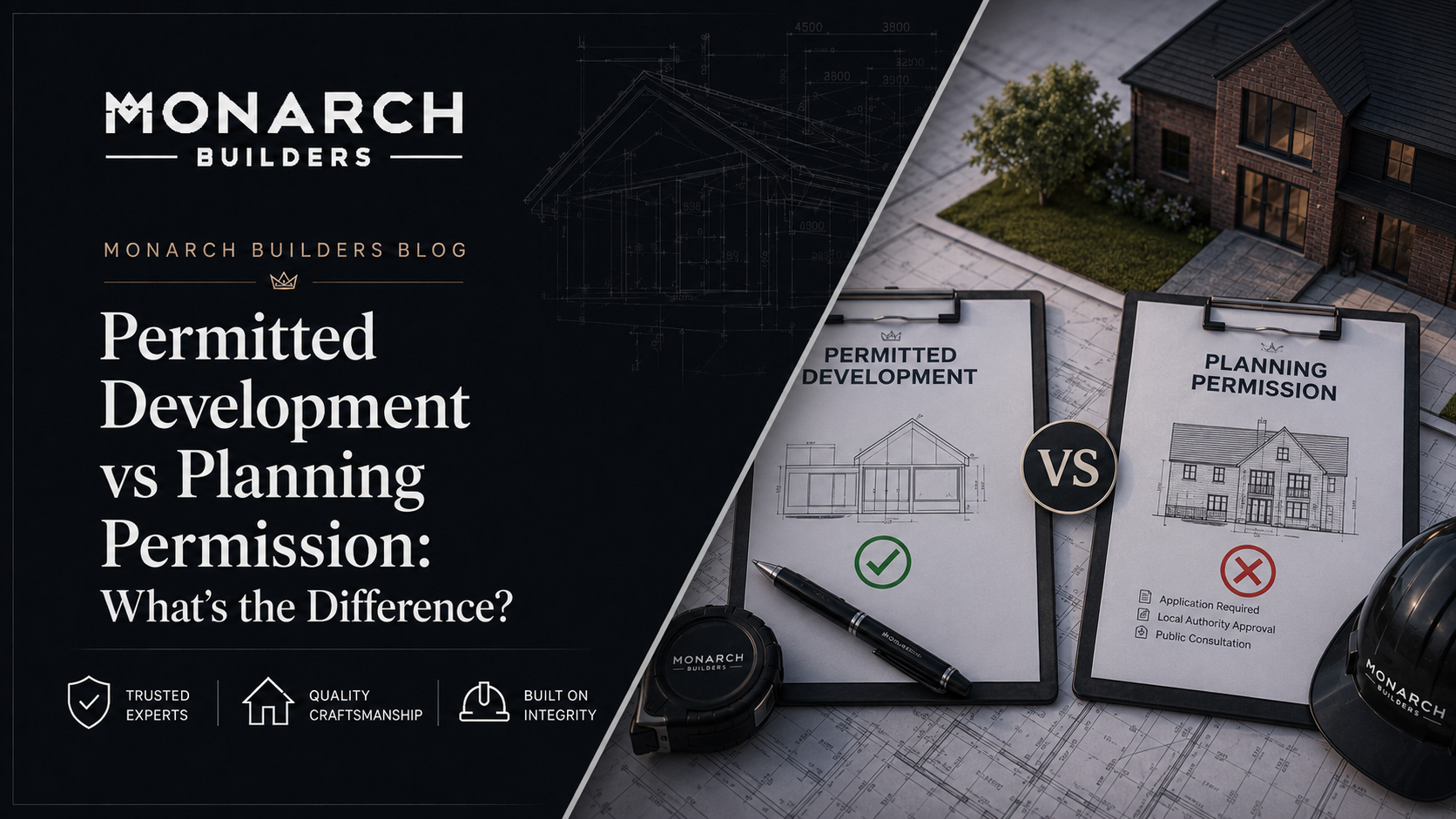
The starting point is understanding that Permitted Development (PD) and full planning permission are two different routes to the same destination: legal authorisation to build. Most straightforward extensions in England are covered by Permitted Development rights, set out in the Town and Country Planning (General Permitted Development) Order — meaning you can proceed without submitting a full planning application, provided your project stays within specific size and design limits.
What Permitted Development Typically Covers
For a standard house (not a flat or maisonette — different, more restrictive rules apply there), Permitted Development commonly allows:
- Single-storey rear extensions up to 3m (terraced/semi-detached) or 4m (detached), extendable further under the Larger Home Extension prior approval scheme
- Loft conversions up to a volume allowance of 40m³ (terraced/semi-detached) or 50m³ (detached), excluding hip-to-gable alterations in some cases
- Outbuildings, garden rooms and sheds, subject to height and coverage limits
- Porches up to 3m² floor area
These allowances come with conditions on height, materials, boundary proximity and roof pitch, so "permitted" doesn't mean "unlimited" — a design that strays outside the limits tips the whole project back into requiring a full planning application.
Where Thanet Homeowners Need to Be Extra Careful
This is the part that catches people out locally. Permitted Development rights are reduced or removed entirely in:
- Conservation Areas — Thanet has several, including parts of Margate Old Town, Ramsgate and Broadstairs, where additional restrictions apply to extensions, cladding, and even some window and door replacements
- Listed buildings — any change, internal or external, typically needs Listed Building Consent regardless of size
- Properties covered by an Article 4 Direction — a specific order some councils use to withdraw PD rights in areas they consider sensitive to uncontrolled change
Because these designations are property-specific rather than borough-wide, the only reliable way to know where you stand is to check your address against Thanet District Council's planning constraints maps, or ask us to check for you as part of your quote — we deal with this every week and can usually tell you quickly whether your project is likely to qualify.
Get It Confirmed in Writing
Even when a project clearly falls under Permitted Development, we always recommend applying to the council for a Lawful Development Certificate (LDC). It isn't legally required, but it's inexpensive relative to the risk it removes: it gives you a formal, dated document proving the work was lawful at the time it was carried out. This matters most when you come to sell — solicitors and buyers routinely ask for it, and without one you may be forced to apply retrospectively, with no guarantee of approval.
And Remember: Building Regulations Still Apply
Whichever route your project takes on the planning side, Building Regulations approval is a completely separate requirement — and it applies almost regardless of whether you needed planning permission or not. We've covered that process in detail in a separate article, since it trips up just as many homeowners as planning permission does.
Our Advice
Before you commit to a design, get the planning question settled first — it shapes what's actually achievable on your plot. On every project we quote across Margate, Ramsgate, Broadstairs and the wider Thanet area, we check the planning position as standard, so you're not left guessing.